
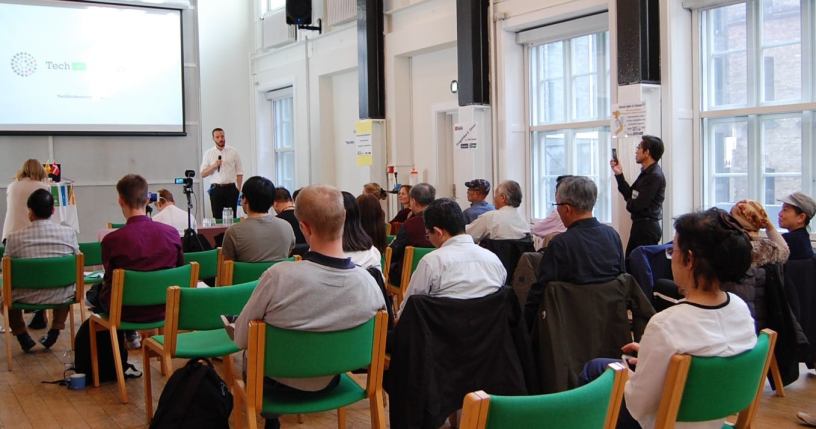
On October 7th, 2021, a seminar took place on the topic “Freedom of Speech and Digital Rights in Vietnam”, organized by the Support Committee for Vietnam (SKVN) with support from International Media Support (IMS), Global Focus and VietTan. The seminar took place in the headquarters of Global Focus in Copenhagen.
Helena Huong Nguyen, chairperson of SKVN, welcomed the participants, both those participating in person and online via Teams. She provided background on the topic of this year’s seminar, which was inspired by the approximately 40 bloggers, Facebookers, and independent journalists making up almost 300 prisoners of conscience. These have either been arrested or sentenced to long-term prison in Vietnam. The intense suppression of freedom of speech and the specific persecution of individuals on social media platforms, such as Facebook and YouTube, is alarming.
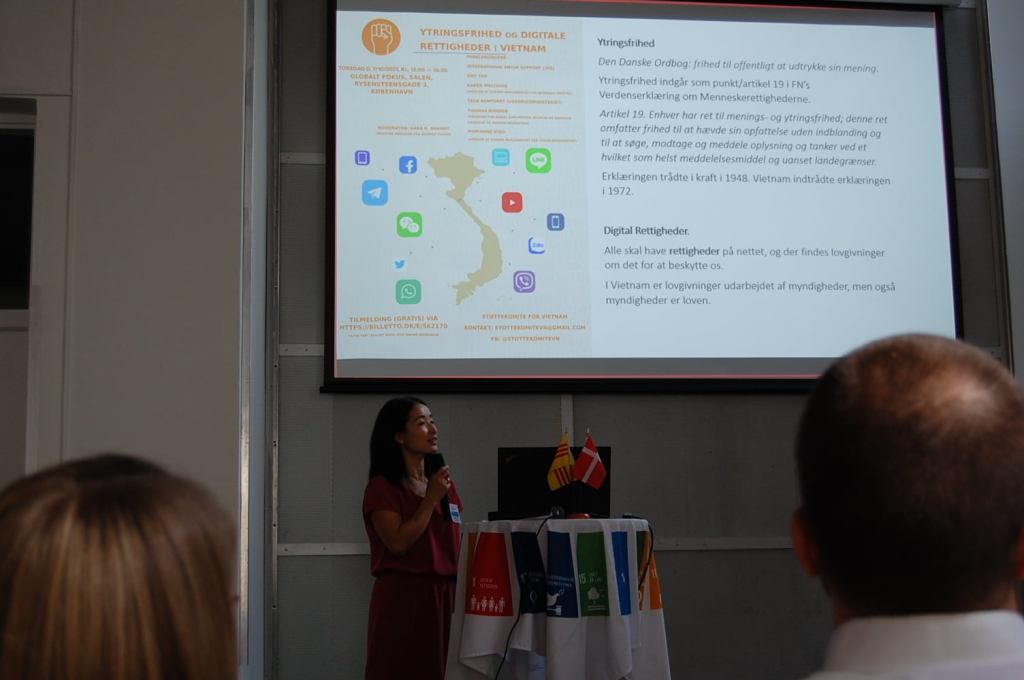
Sara Brandt, political advisor at Global Focus, moderated the seminar. She discussed the link between the seminar and the Danish government initiative “Tech for Democracy”. The purpose of which is to ensure that technological development benefits and supports freedom of speech, democracy and protest movements all over the world, including Vietnam, where such support is much needed.
The seminar’s first speaker was Emilie Lehmann-Jacobsen, Asia-advisor at International Media Support (IMS). IMS works to support media and independent journalism, and provides direct support to journalists in vulnerable countries. On a personal level, Emilie has had significant experience and interest in Vietnam through her Ph.D. thesis and her multiple visits to Vietnam in the context of writing it. She expressed her concern for the limited protection of rights for journalists in Vietnam. On multiple occasions, through her international collaborations, she has attempted to promote this for Vietnam.
Michel Tran Duc, residing in France and a representative of VietTan, a global organization that works to promote human rights and democracy in Vietnam, presented the Vietnamese government’s internet policy since 2008. As well as the government’s censor and suppression of online expression. These include cyber troops (Force 47) with internet trolls (of which there are estimated to be 10,000), and hacker group Ocean Lotus. Through legislation and prioritized resourcing, the communist government limits citizens’ presence on the internet. Furthermore, the government actively collaborates with Facebook and YouTube to block content critical of the government and deactivates the Facebook profiles of activists for months at a time. The many arrests and prison sentences constitute only the tip of the iceberg of uncountable threats, harassment, brutality and blackmail against families, employers, landlords, lawyers, teachers, etc. VietTan itself is an excellent example of this: the organization’s posts on Facebook and YouTube often get blocked, and their members residing in Vietnam (including those with foreign citizenship) have been imprisoned or have been forced to operate “underground”. Through international campaigns, activism training, and network building with like-minded NGOs and civil rights-organizations, VietTan contributes to the fight to secure citizens’ rights to freedom of speech in Vietnam.
SKVN brought forward a witness video as an example of the consequences activists can face when they take part in advocating for freedom of expression on the internet. The video described the situation of Bui Van Thuan, a chemistry teacher, who was arrested a month ago for his critical comments on Facebook about the government. The video also showed Nguyen Van Trang, an activist who has fled to Thailand to avoid the 12-15 years of prison sentence that his friends have received. His family and him are currently residing in Thailand illegally as stateless, and are at risk of forced repatriation from the Thai police. The video can be accessed here: https://www.youtube.com/watch?v=1epikeKgt-Q
The story of the lawyer and activist, Nguyen Van Dai, was also touched upon in the video. YouTube and Facebook have on many occasions blocked his content and videos, and made them inaccessible to viewers from Vietnam, despite him being based in Germany.
Christian B. Fassov from the Ministry of Foreign Affairs of Denmark Tech Office presented the initiative “Tech for Democracy”, which the Danish government has established in collaboration with civil society organizations (CSOs). The purpose of the initiative is to secure signed pledges from all relevant partners, including states, tech companies in Silicon Valley, multilateral organizations, grassroots organizations, and CSOs. The pledge constitutes a commitment that signees will leverage technological and digital development to support democracy, human rights and protest movements across the world. A concrete action plan will follow the signed pledge.
Following a 15-minute break, Karen Melchior, member of the European Parliament for the Danish Social Liberal Party (Radikale Venstre) discussed the background, content and significance of the European Union’s Magnitsky Act, which the Parliament adopted in December 2020. There are still some challenges and shortcomings with the law in order to achieve its full purpose, i.e. a follow-up to the frozen millions and billions that must be returned to the population, and that some EU Member States (e.g. Malta and Cyprus) offer corrupt leaders citizenship for payment or investment in these countries.
Mariane Vind, member of the European Parliament for the Danish Social Democrats (Socialdemokratiet) participated in the SKVN seminar for the second time. This time online due to the plenary session taking place in Strasbourg on the same day. Marianne talked about the purpose of the free trade agreement between the European Union and Vietnam (EVFTA) and the obligations and human rights protections that will be required of Vietnam going forward. She has a special interest and attention to the new labour law in Vietnam (passed on January 1st, 2020), and has promised to support and promote independent labour unions in Vietnam.
The last, but not less exciting, topic was brought forward by Thomas Rohden, chairperson for the Danish China-Critical Society (Dansk Kina-Kritisk Selskab) and candidate for the Danish Social Liberal Party to the Capital Region Board. He talked about the limitations on his ability to travel freely and to his career opportunities following a possible Chinese order of arrest on him and several other Danish politicians. This order of arrest was made in response to their support of Ted Hui, a democracy activist and politician in Hong Kong, and his evacuation from the country. Thomas noted that his sacrifice was small compared to that of his friends, who remain imprisoned in Hong Kong. This is also an important message for those who support democracy movements, about overcoming fear and harassment by authoritarian countries such as Vietnam.
The seminar ended with a round of suggestions by all panel participants on next steps to follow. It was mentioned that sanctions against Vietnam are a good option. However, only in the longer term, as EU members must be anchored in the new Magnitsky law and the trade agreement. In the meantime, active efforts are needed to raise international awareness of the challenges facing Vietnam. Furthermore, there was also a broad consensus that the “Tech for Democracy” initiative will provide a great opportunity to influence perspectives on and collaborations with Vietnam. In particular, there is a need for support for the development of civil society in Vietnam, e.g. to promote better framework conditions for media freedom in the country, and encouragement was made for SKVN to follow up with the initiative.
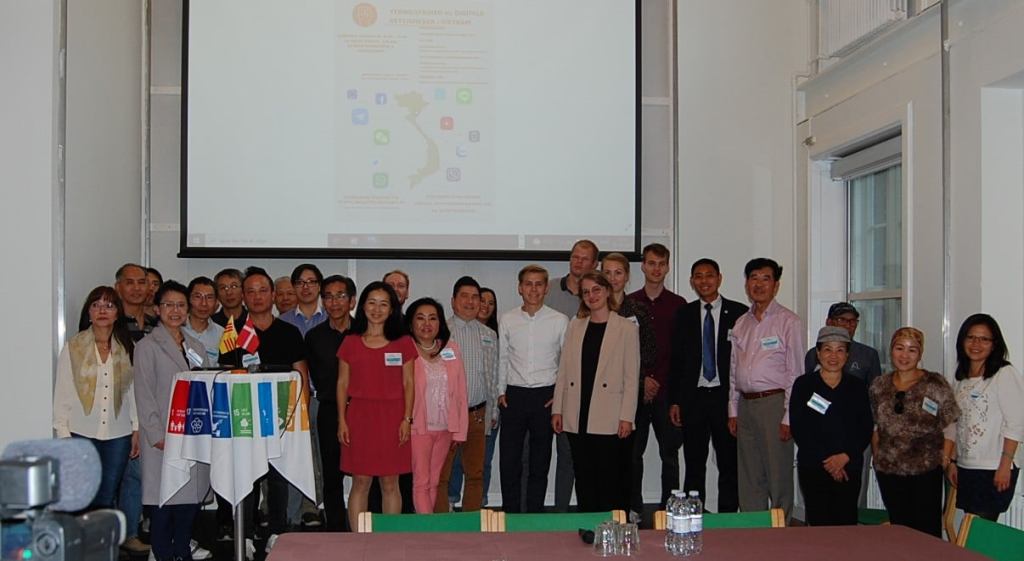
Prior to the seminar, SKVN made an appearance at Facebook’s Danish offices at Carlsberg city, where they delivered a letter of appeal. Following the seminar, they conducted “A Walk for Human Rights” to the office of Google Copenhagen, delivering a letter of appeal. Both letters appealed to the tech companies to consider and commit to their social responsibility and respect for human rights, rather than become vehicles for an authoritarian state like Vietnam to combat democratic voices.
Support Committee for Vietnam
StotteKomiteVN@gmail.com
FB @SKVN
 Viet Tan Nordic